What a homework checker app actually does
The most useful way to think of a homework checker app is as a solver: it solves the question you give it and shows the solution step by step, rather than marking your work the way a teacher does. The checking is your part: you solve the problem yourself first, then scan or type the same question, and compare your steps with the app's steps to find where you went wrong.
Socratic Solve, for example, works from the question, not from your written answer, so it won't circle your mistake for you. But the comparison is worth more than a tick or a cross anyway. A grade tells you that you were wrong. A full worked solution, placed next to your attempt, shows you where and usually why.
Why comparing steps beats comparing final answers
Comparing final answers only tells you match or no match. Comparing steps tells you much more:
- Wrong answer: the first line where your work and the solution split is the mistake. Everything after it is usually that one error carried forward.
- Right answer, different route: you've learned a second method, and it's often shorter.
- Right answer, broken method: sometimes two errors cancel out, or a guess happens to land. Only a step comparison catches this, and it's exactly the kind of luck that fails on the test.
If you want a routine for checking without any app (substitution, estimation, units, working backwards), see our 5-minute routine for checking homework answers. This guide is about using an app well.
How to use a homework checker app: 6 steps
- Attempt the problem first, on paper. Write every step, not just the answer. Without your own working there's nothing to compare.
- Scan or type the question, not your answer. Photograph the printed or handwritten question, crop to one problem, and check that the app read it correctly. A misread exponent or a dropped minus sign produces a perfect solution to the wrong problem.
- Compare line by line. Put your page next to the screen and walk through both together, top to bottom.
- Find the first divergence. Stop at the first line where your work and the solution disagree. That single line is the thing to understand.
- Classify the mistake. Name what kind of error it was (see the table below).
- Redo a similar problem without help. Pick the next question of the same type and solve it cold. If it goes wrong again, repeat the comparison.
Four kinds of mistakes to look for
| Mistake type | What it looks like | What to do next time |
|---|---|---|
| Concept | Wrong formula, wrong method, or a rule applied where it doesn't hold. | Re-read the topic in your notes, then do two practice problems on that exact idea. |
| Arithmetic or sign | Right method, but a dropped negative, a slipped decimal, or a multiplication error. | Slow down on the risky step (distributing negatives, dividing by decimals) and substitute your answer back in. |
| Reading the question | Solved for the wrong quantity, missed a condition, or used the wrong given value. | Underline what the question asks for before you start, and re-read it before writing the final answer. |
| Units | Wrong unit, no unit, mixed units (cm with m, g with kg), or the wrong molar mass. | Write units on every line so a mismatch shows up immediately. |
Worked example 1: finding the wrong step in algebra
Question: Solve 3(x − 4) − 2(x − 5) = 7.
| Step | Student's attempt | Worked solution |
|---|---|---|
| 1. Expand | 3x − 12 − 2x − 10 = 7 | 3x − 12 − 2x + 10 = 7 |
| 2. Collect terms | x − 22 = 7 | x − 2 = 7 |
| 3. Solve | x = 29 | x = 9 |
First divergence: step 1. The student multiplied −2 by x but not by −5. Since −2 × −5 = +10, the term should be +10, not −10. Steps 2 and 3 are done correctly; they just carry the error forward. Mistake type: sign error when distributing a negative.
Confirm by substitution: with x = 9, 3(5) − 2(4) = 15 − 8 = 7, which matches. With x = 29, 3(25) − 2(24) = 75 − 48 = 27, which doesn't. This final check against the original equation means you're not just trusting the app. For more practice with this kind of problem, see the algebra solver with steps guide.
Worked example 2: finding the wrong step in chemistry
Question: How many grams of water form when 4.0 g of hydrogen gas reacts with excess oxygen? The balanced equation is 2H₂ + O₂ → 2H₂O. (Molar masses: H = 1.008 g/mol, O = 15.999 g/mol.)
| Step | Student's attempt | Worked solution |
|---|---|---|
| 1. Moles of H₂ | 4.0 g ÷ 1.008 g/mol = 3.97 mol | 4.0 g ÷ 2.016 g/mol = 1.98 mol |
| 2. Mole ratio | 2 mol H₂ : 2 mol H₂O, so 3.97 mol H₂O | 2 mol H₂ : 2 mol H₂O, so 1.98 mol H₂O |
| 3. Grams of water | 3.97 mol × 18.015 g/mol = 71.5 g | 1.98 mol × 18.015 g/mol = 35.7 g |
First divergence: step 1. The student used the molar mass of a hydrogen atom (1.008 g/mol) instead of a hydrogen molecule, H₂ (2 × 1.008 = 2.016 g/mol). The mole ratio and the final multiplication are both set up correctly, so the whole error comes from that one number. Mistake type: units and formula (molar mass of the wrong species).
Confirm with a sanity check: water is only about 11% hydrogen by mass (2.016 ÷ 18.015 ≈ 0.112), so 4.0 g of hydrogen can make at most about 4.0 ÷ 0.112 ≈ 36 g of water. An answer of 71.5 g is impossible, while 35.7 g fits. More stoichiometry help is in the chemistry homework help guide.
Compare your steps tonight
Download Socratic Solve free, scan a question you've already attempted, and find the exact line where your working went off track.


What to look for in a homework checker app
- Subjects covered. If you take algebra, physics and chemistry, one app that handles all of them beats three separate ones.
- Step quality. You need every intermediate line with a short reason, not a final answer with a couple of jumps. If a step skips the part you got wrong, the comparison can't show it.
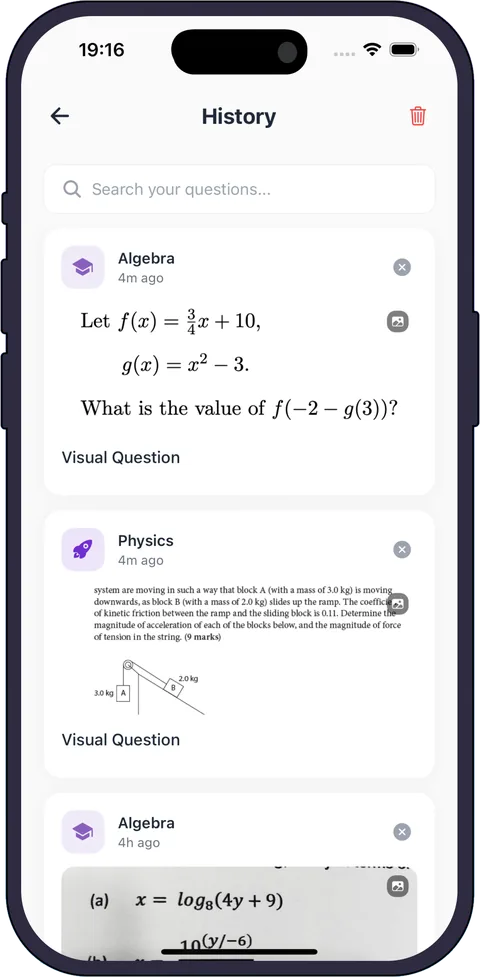
- History. A saved, searchable history lets you see recurring mistakes over weeks, not just tonight. Being able to filter by subject makes patterns easy to spot.
- Handwriting and input options. Look for an app that scans both printed and handwritten questions, and lets you type or upload a photo when the camera struggles.
- Price model. Try any free tier on a few real questions from your own class before paying, and check whether a subscription renews automatically.
For a side-by-side look at popular options, see our comparison of the best homework helper apps.
Limits: what a homework checker app can't do
- It can misread the question. Blurry photos, messy handwriting and stacked fractions cause misreads. Always read the app's version of the question before you trust the solution.
- It can be wrong. AI solutions are study aids, not answer keys. When the app and you disagree, test both answers against the original question with a substitution, unit check or estimate, as in the examples above.
- It may use a different method from your class. A correct but unfamiliar method can lose marks if your teacher expects a specific approach. Ask when in doubt.
- It doesn't replace the attempt. Reading a solution feels like understanding; solving a similar problem alone afterwards is the proof.
Using Socratic Solve as your homework checker
Socratic Solve fits the compare-your-steps workflow. You scan a printed or handwritten question with your camera, type it, or upload a photo, and it returns a step-by-step solution with properly rendered math notation. It covers math (algebra, geometry, trigonometry, logarithms, matrices, calculus), physics, chemistry, biology, history and more, and works in 20+ languages on iPhone, iPad and Android.
Every question you check is saved in your learning history, tagged by subject and searchable. Over a few weeks that history shows your patterns: if most of your saved algebra questions trace back to distributing negatives, you know what to drill before the test. You start with free credits, and an optional auto-renewing subscription unlocks more. Read more about how these tools work in our guides to the AI homework helper and to taking a picture of your homework.