
How to check your homework answers: the short version
To check your homework answers, re-read what the question actually asks, then test each answer with a different method from the one you used to get it: plug it back in, estimate, check the units, or work backwards. Only after that should you compare your working with a worked solution. The routine below takes about five minutes a sheet and catches most of the errors that cost marks.
Prefer to use an app for the comparison step? See our homework checker app guide.
The 5-minute checking routine
- Re-read the question (30 seconds). The #1 mark-loser isn't wrong math; it's answering the wrong question. Solved for x when they asked for 2x? Gave the radius instead of the diameter?
- Sanity-check the magnitude (30 seconds). A car doing 4,000 km/h, a probability of 1.7, a negative mass: wrong answers usually look wrong if you glance at them as physical claims.
- Check units and signs (1 minute). Every physics and chemistry answer needs a unit; every algebra answer deserves a ten-second substitution back into the original equation.
- Scan and compare (2 minutes). Photograph the question with Socratic Solve and compare its step-by-step solution to your working line by line, not just the final answer.
- Fix and log (1 minute). Correct the error, and note what kind it was. Three sign errors in a week is a pattern worth knowing about before the test.
Five checking methods, with examples
The strongest check uses a different route from the one that produced the answer. Re-reading your own working tends to repeat the same mistake, because your brain sees what it expects to see.
1. Substitution: plug the answer back in
For any equation, put your answer into the original equation (not a later line, which may already contain the error). Say you solved 2(x + 3) = 4x − 8 and got x = 7. Left side: 2(7 + 3) = 20. Right side: 4(7) − 8 = 20. They match, so the answer is right. If they don't match, the answer is wrong, full stop. For quadratics, check both roots. For systems of equations, check every equation.
2. Estimation: is it roughly the right size?
Round the numbers and do the calculation in your head. For 48.7 × 2.1, think 50 × 2 = 100. The exact answer is 102.27, so a calculator result of 1,022.7 means a slipped decimal point. Estimation won't prove an answer right, but it catches order-of-magnitude errors in seconds.
3. Units: does the answer have the right kind of unit?
Carry units through every line. A runner covers 150 m in 12 s: 150 m ÷ 12 s = 12.5 m/s, and m/s is a speed, which is what was asked. If your units come out as m·s or s/m, the formula is upside down somewhere. This is the fastest check in physics and chemistry.
4. Reverse operations: work backwards
Undo what you did. If 864 ÷ 24 = 36, then 36 × 24 should give 864, and it does. In calculus, differentiate your integral: if you found that the integral of 2x·cos(x²) is sin(x²) + C, the derivative of sin(x²) is 2x·cos(x²), which confirms it. In chemistry, count atoms on both sides of a balanced equation: in 2H₂ + O₂ → 2H₂O there are 4 H and 2 O on each side.
5. Word problems: answer the question they asked
Word problems fail at the last line more than anywhere else. Example: a rectangle's length is 3 cm more than its width and its area is 40 cm². Find the perimeter. Setting up w(w + 3) = 40 gives w² + 3w − 40 = 0, so w = 5 or w = −8. A width can't be negative, so w = 5 cm and the length is 8 cm. Many students stop there and write "5 cm." But the question asked for the perimeter: 2(5 + 8) = 26 cm. Check three things: you rejected impossible answers, you answered the quantity asked for, and you included units.
Check tonight's homework in 5 minutes
Download Socratic Solve free and compare your answers against full worked solutions.


Checklist by subject
| Subject | Quick checks |
|---|---|
| Algebra | Substitute into the original equation; check every root; reject answers outside the domain (negative inside a log or square root); flip the inequality sign if you multiplied or divided by a negative. |
| Geometry and trig | Angles in a triangle sum to 180°; the hypotenuse is the longest side; sin and cos stay between −1 and 1; calculator in degrees or radians as the question requires. |
| Calculus | Differentiate your integral; check the sign of a derivative against the graph (rising means positive); include + C on indefinite integrals. |
| Physics | Units on every answer; convert to SI units before substituting; direction and sign for vectors; plausible size (no 4,000 km/h cars). |
| Chemistry | Atoms balance on both sides; charges balance in ionic equations; moles convert with the right molar mass; significant figures match the data. |
| Written subjects | Re-read the prompt; every claim answers it; dates, names and definitions are checked against your notes or textbook. |
Compare steps, not answers
Matching final answers can hide a broken method that happened to work this once. Comparing the working is stronger: find the first line where a worked solution and yours diverge. Three outcomes:
- Same route, same answer: done, submit with confidence.
- Different route, same answer: you just learned a second method free. Often the other one is shorter.
- Divergence: that exact line is your lesson for today. Understand it, fix everything downstream, redo one similar problem to confirm.
This works in any subject, but it's most powerful in chain-style problems (multi-step algebra and stoichiometry), where one early slip poisons everything after it. Keep in mind that AI solutions are study aids and can occasionally be wrong too. If a worked solution disagrees with your answer, run a substitution or unit check on both before deciding which is right.
Redo it or compare with a worked solution?
- Redo from scratch when a check fails but you can't see why, or when the problem is short. A fresh attempt on a blank page often avoids the original slip.
- Compare with a worked solution when you've redone it and still disagree with yourself, when the problem is long and multi-step, or when you're not sure your method is even the right one.
- Ask your teacher when the worked solution uses a method you haven't been taught. Graders often expect the class method.
Turn checking into test prep
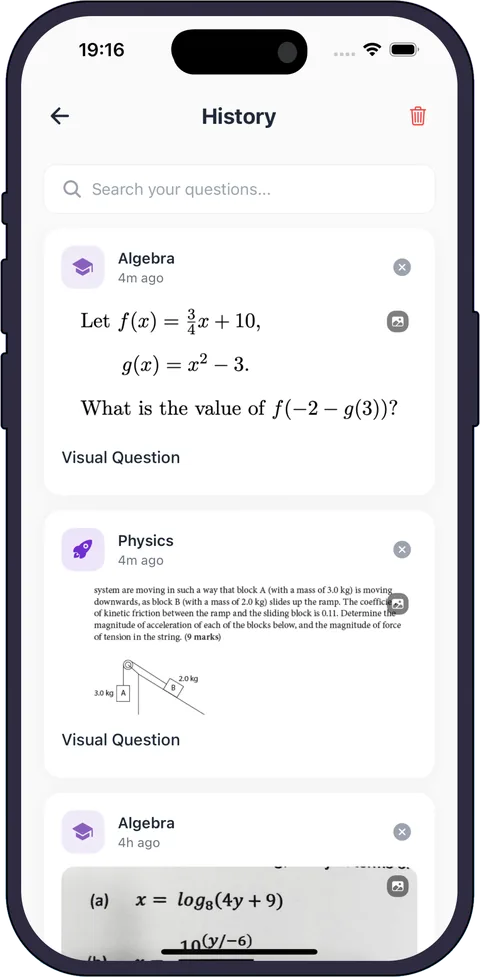
Every question you scan is saved in the History tab, tagged by subject and searchable. Your history becomes a log of precisely the problems you got wrong the first time, which is the highest-value revision list that exists. The week before the exam, re-solve them cold. Download Socratic Solve free and start the habit tonight.