The five kinds of history homework questions
History questions look endless, but nearly all of them fall into five types. The verb tells you which one you're facing:
| Type | Look for | A good answer has |
|---|---|---|
| Recall | who, what, when, identify, define | The fact, plus one sentence on why it matters |
| Cause and effect | why, explain, led to, result | The cause, the result, and the link between them |
| Compare | compare, contrast, change over time | A similarity or difference with evidence for both sides |
| Source analysis | according to the document, the author's purpose | What the source says, who made it, why, and for whom |
| Argument | evaluate, to what extent, assess | A thesis, evidence from several sources, and reasoning |
A common way to lose points is answering the wrong type: describing an event when the question asked why it happened, or summarizing a document when it asked for the author's purpose.
How to answer a short-answer history question
Teachers use different names for it, but the structure is the same: claim, evidence, explanation.
- Claim: answer the question directly in your first sentence. No warm-up.
- Evidence: add something specific: a person, a law, a date, a number or a short quote. "Many people were unhappy" is not evidence.
- Explanation: say how the evidence supports your claim. It's the easiest step to skip, and it's where the analysis happens.
Question: Identify one reason the colonists gave for declaring independence in 1776.
Weak answer: "They didn't like the British."
Strong answer: "The colonists objected to being taxed without their consent. The Declaration of Independence lists among its grievances against the King 'imposing Taxes on us without our Consent.' Because the Declaration argues that governments get their power from the consent of the governed, taxing people who had not agreed to it was proof, in the colonists' view, that British rule had lost its legitimacy."
Same fact, but the strong answer names the source and explains why the evidence matters.
How to analyze a primary source, step by step
Source questions are where many students go wrong, because summarizing the document feels like answering. It isn't. The College Board's AP history rubrics reward explaining a document's point of view, purpose, historical situation and audience, and those four questions work for any primary source in any class.
Source: the Declaration of Independence, adopted by the Continental Congress on July 4, 1776 (text from the National Archives):
- Historical situation: by July 1776 the colonies were already at war with Britain; the Continental Congress had created the Continental Army in June 1775. The Declaration explained a break that was already happening.
- Audience: the document says so itself. Its first paragraph says "a decent respect to the opinions of mankind" requires the colonists to explain their reasons, so it was written for the world, not just for the King or the colonists.
- Purpose: to justify independence. If governments get "their just powers from the consent of the governed," then a government that abuses those rights can be replaced, which is exactly what the next lines argue.
- Point of view: Thomas Jefferson wrote the draft, which was revised by a committee and then by Congress (86 edits, according to the National Park Service). These were colonial leaders making the case against British rule. Congress cut a passage blaming the King for the slave trade.
Going further: strong answers notice tension in a source. "All men are created equal" did not describe the America of 1776. Later Americans held the document to its own words: the 1848 Declaration of Sentiments asserted that "all men and women are created equal," and in 1852 Frederick Douglass asked, "What to the Slave is the Fourth of July?" Pointing out a gap like this, with evidence, is the kind of complexity the AP rubric gives a point for.
If your assignment is a DBQ
A document-based question asks you to build an argument from a set of sources. On the AP U.S. History exam it's one hour (including a 15-minute reading period) with seven documents, scored on a 7-point rubric:
- Thesis/claim (1 point): a defensible claim that answers the prompt, not a restatement of it.
- Contextualization (1 point): the broader historical background, in more than a phrase.
- Evidence (3 points): up to 2 for using the documents to support your argument (describing them, not just quoting), plus 1 for a specific piece of evidence that isn't in the documents.
- Analysis and reasoning (2 points): 1 for explaining the point of view, purpose, historical situation or audience of at least two documents, and 1 for showing a complex understanding of the topic.
Even outside AP classes, most DBQ assignments reward the same moves.
How to use an AI history helper the right way
AI tools are good at some history tasks and risky at others. Use them for:
- Decoding the question. "What is this question actually asking me to do?"
- Explaining a cause or connection you didn't follow in class or in the reading.
- Checking your own answer after you've written it, to see if you missed a key point.
- Quizzing yourself before a test.
Be careful with:
- Names, dates and quotes. AI can state a wrong date or misquote a document with total confidence. Check facts against your textbook or a primary source, like the founding documents on the National Archives website.
- Your actual answer. History grades your analysis. Pasting AI-written text into an assignment usually breaks school rules, and your school may have a specific AI policy. Follow it.
Socratic Solve handles history alongside math and science. Scan a printed or handwritten question with your camera, or type it, and you get an explanation broken into steps, which works well for "explain why" and "what led to" questions. Every question is saved to a searchable history tagged by subject, so your notes are in one place before a test. It works in 20+ languages on iPhone, iPad and Android, with free credits to start and an optional subscription for regular use. Use it to understand the question, then write the answer in your own words.
We tested an AI history helper on a real exam question
History is where AI answers are easiest to misuse and hardest to judge, so we ran a released question from the 2022 NAEP U.S. History assessment for 8th grade through Socratic Solve 1.2 (on an iPhone simulator, uploaded from the photo library) on November 9, 2026. It quotes the 1848 Declaration of Sentiments (the document mentioned above) and asks two things: which document the authors used as their model, and one reason they chose it.
- Part A: it chose D, the Declaration of Independence, which is correct, and pointed to the borrowed opening ("We hold these truths to be self-evident") and the list of grievances, which mirrors the charges against King George III.
- Part B: its reason was that the Declaration of Independence was a well-known statement of rights and equality, so copying its form let the women claim the same rights as men and expose a nation founded on equality that denied women theirs.
- How to use it: that Part B answer makes a solid claim, but it is the app's wording, not yours. To earn the point, restate the reason in your own words and quote one phrase from the excerpt as evidence, such as "all men and women are created equal."
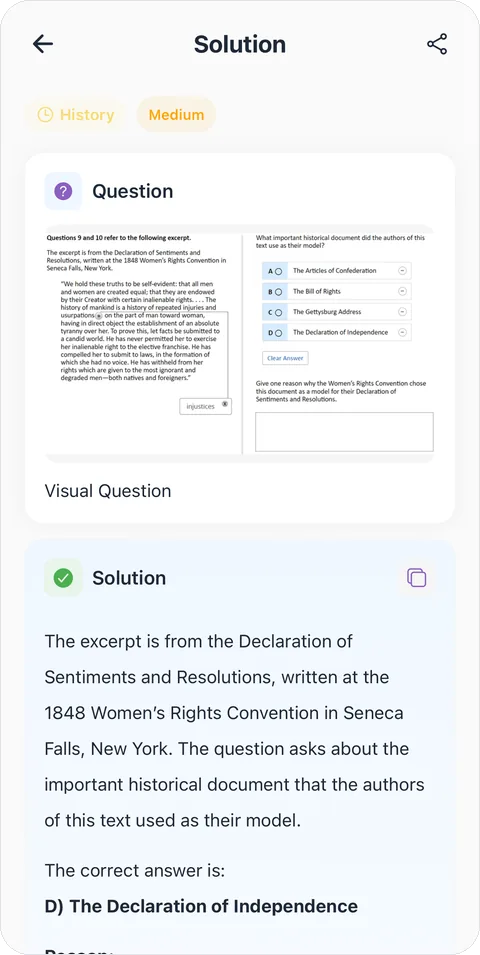
Question: NAEP 2022 U.S. History, Grade 8, released item 2022-8H8 #9, from the NAEP Questions Tool. Released NAEP questions are in the public domain.
Free history homework help that isn't AI
- Your textbook and class notes. Your teacher grades against what was taught, so start there.
- Khan Academy. Free courses in U.S. history, world history, U.S. government and civics, and art history.
- UPchieve. A nonprofit offering free online tutoring, including U.S. history, AP World History and history essay help, to students who pass its eligibility check.
- Primary sources online. The National Archives publishes full transcripts of the Declaration, the Constitution and the Bill of Rights.
- Your teacher. A two-line question before the deadline is easier than fixing a wrong essay after it.
Before you hand it in: a 5-point check
- Did you answer the question type that was asked (explain, compare, analyze)?
- Does every claim have specific evidence: a name, date, place, number or quote?
- Did you explain how each piece of evidence supports your point?
- Have you checked every date and name against your textbook or a primary source?
- Is it in your own words?
For a general routine that works in every subject, see our guide on how to check your homework answers.
Try Socratic Solve free
Snap a history, science or math question and get an explanation broken into steps. Free credits to start on iPhone, iPad and Android.