
The short answer
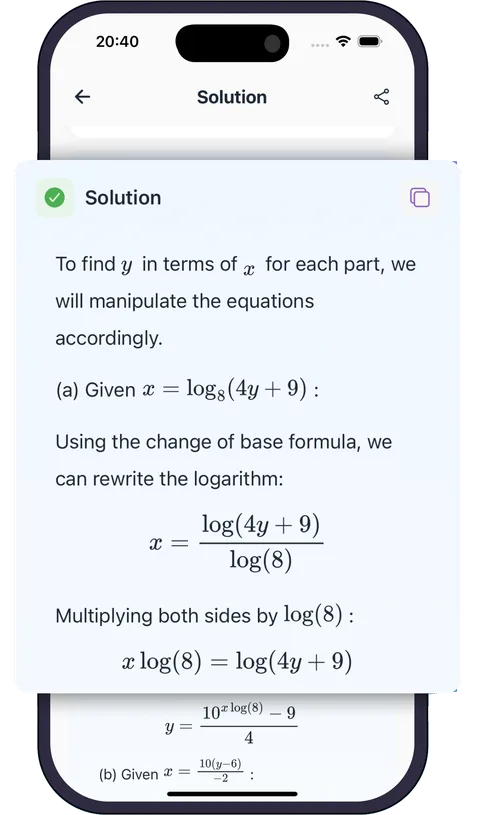
Socratic Solve solves math problems from a photo. Open the app, tap Scan Question, point the camera at the problem, and the AI returns the answer with the complete working: each algebraic move shown on its own line in real math notation, not a wall of plain text.
- Download Socratic Solve free on iPhone, iPad or Android.
- Snap the problem, printed or handwritten.
- Read the step-by-step solution, then try the next one yourself.
Scan your first math problem free
Socratic Solve is free to download, and the full worked solution is one photo away.


What a photo math solver can handle in 2026
| Topic | Example of what you can scan |
|---|---|
| Arithmetic & fractions | Multi-step order-of-operations, fraction simplification |
| Algebra | Linear & quadratic equations, systems, inequalities, factoring |
| Logarithms & exponents | Solve x = log₈(4y + 9) for y, change of base, growth problems |
| Geometry & trigonometry | Angles, areas, triangle problems, identities |
| Matrices & linear algebra | Determinants, inverses, augmented-matrix systems |
| Calculus | Derivatives, integrals, limits (worked calculus examples) |
| Word problems | The AI reads the sentences, sets up the equation, then solves it |
That last row matters: older camera calculators could only read a bare equation. Because Socratic Solve is built on AI that understands language as well as notation, the dreaded "a train leaves the station…" problem is scannable too.
What to look for in an app that solves math problems by taking a picture
Plenty of apps can read an equation from your camera. Fewer are actually useful for homework. Whichever app you use, check it against this list:
- Full working, not just the answer. Teachers grade the method. Every line should be shown, ideally with the rule that justifies it ("distribute", "subtract 2Z from both sides").
- Proper math notation. Stacked fractions, raised exponents and subscripted log bases are far easier to follow than plain text like x^2/(3x−1).
- Handwriting support. Most homework is on paper in your own writing, not in a printed textbook.
- Word problems. The app should read the sentences and set up the equation, since that's the step most students find hardest.
- A typing fallback. When a photo won't read cleanly, you need to be able to type the problem instead.
- Saved history. Problems you struggled with are the best revision material before a test.
- Clear pricing. Know what's free before you rely on it the night before a deadline.
Socratic Solve covers each of these: step-by-step solutions in rendered notation, camera scans of printed or handwritten problems, typed questions and photo uploads, and a searchable history tagged by subject. It's free to download with free credits to start, and an optional auto-renewing subscription if you need more.
Why the steps matter more than the answer
Most math homework is graded on working, and most math tests don't let you photograph anything. The answer alone is worth almost nothing. The method is what transfers. A good solver shows you the same solution structure your teacher expects: identify what's given, choose the rule, apply it line by line, simplify, state the result. Read the steps once, then redo the problem on paper without the app. If your working matches, you own the method. For a deeper look at equation solving, see the algebra solver with steps guide.
A simple routine that works:
- Attempt it first, even if you only get two lines down.
- Find the line where your working and the solution split. That's the exact thing you need to learn, and it's usually one rule.
- Redo the problem from a blank page with the app closed.
- Solve a similar problem from the same exercise on your own, then scan it only to check.
Worked example: solving 2(A − B + Z) = 3(Z − A) for Z
Here's the equation from the top of this page, worked the way a good solver should lay it out. The goal is to get Z on its own.
| Step | Working | Why |
|---|---|---|
| 1 | 2A − 2B + 2Z = 3Z − 3A | Expand both brackets: multiply every term inside by 2 and by 3 |
| 2 | 2A − 2B = Z − 3A | Subtract 2Z from both sides so Z appears only once |
| 3 | 5A − 2B = Z | Add 3A to both sides |
| 4 | Z = 5A − 2B | Rewrite with Z on the left |
Check it with easy numbers. Pick A = 2 and B = 1. The formula gives Z = 5(2) − 2(1) = 8. Left side: 2(2 − 1 + 8) = 2(9) = 18. Right side: 3(8 − 2) = 3(6) = 18. Both sides match, so the rearrangement is right.
Where students usually slip: step 1. If you forget to multiply the 2 into the −B, you get 2A − B + 2Z, and the final answer comes out as Z = 5A − B. If your answer differs from the app's by one term like that, the expansion step is the place to look.
How to check a math answer, with or without the app
- Substitute it back. If x² − 5x + 6 = 0 gives x = 2 and x = 3, test one: 2² − 5(2) + 6 = 4 − 10 + 6 = 0. It works.
- Use easy numbers for formulas. When you solve for a letter, plug in simple values like the A = 2, B = 1 check above.
- Check inverses. Solving x = log₈(4y + 9) for y gives y = (8x − 9)/4. Try x = 2: y = (64 − 9)/4 = 13.75, and 4(13.75) + 9 = 64 = 8², so log₈(64) = 2 as it should.
- Sanity-check size and sign. A negative area, a probability above 1 or an angle of 400° in a triangle means something went wrong.
- Match the form that was asked for. Exact value or decimal, degrees or radians, simplest form, correct units.
Photographing math: what trips scanners up
- Tiny superscripts: get close so x² doesn't read as x2.
- Glare on glossy pages: tilt the book away from the light.
- Multiple problems in frame: crop to the one you're solving.
- Very messy handwriting: the scanner is forgiving, but if a 4 looks like a 9 to you, it will to the AI. Type it instead; Socratic Solve accepts typed questions too.
Writing math so a scanner can read it
- Make x and × different. Write x as two curves, or use a dot or brackets for multiplication.
- Raise exponents clearly. Write them visibly higher and smaller than the base.
- Draw long fraction bars. The bar should run past both the numerator and the denominator.
- Use brackets when in doubt. Is 1/2x meant as 1/(2x) or (1/2)x? Brackets settle it for the scanner and your teacher.
- Separate look-alikes. Cross your 7s and Zs, and keep 1 and 7, 5 and S, 0 and O distinct.
- Use dark ink on a clean page. Faint pencil and busy backgrounds make reading harder.
Where photo math solvers still struggle
Even with a clean photo, some problems need extra care with any solver:
- Values you have to read off a graph or unlabelled diagram. If the numbers aren't written down, write or type them in.
- "Use method X" instructions. If the question says "solve by completing the square", include that line in the photo, or the solver may pick a different method.
- Multi-part questions. Part (c) often uses your answer to part (b). Scan the setup with the part you need.
- Proofs. Your teacher may expect a specific format, such as a two-column geometry proof. Use the steps as a guide to the logic, then write it in the required format.